


Swiss Symphonic Music
Rediscovering the Swiss repertoire
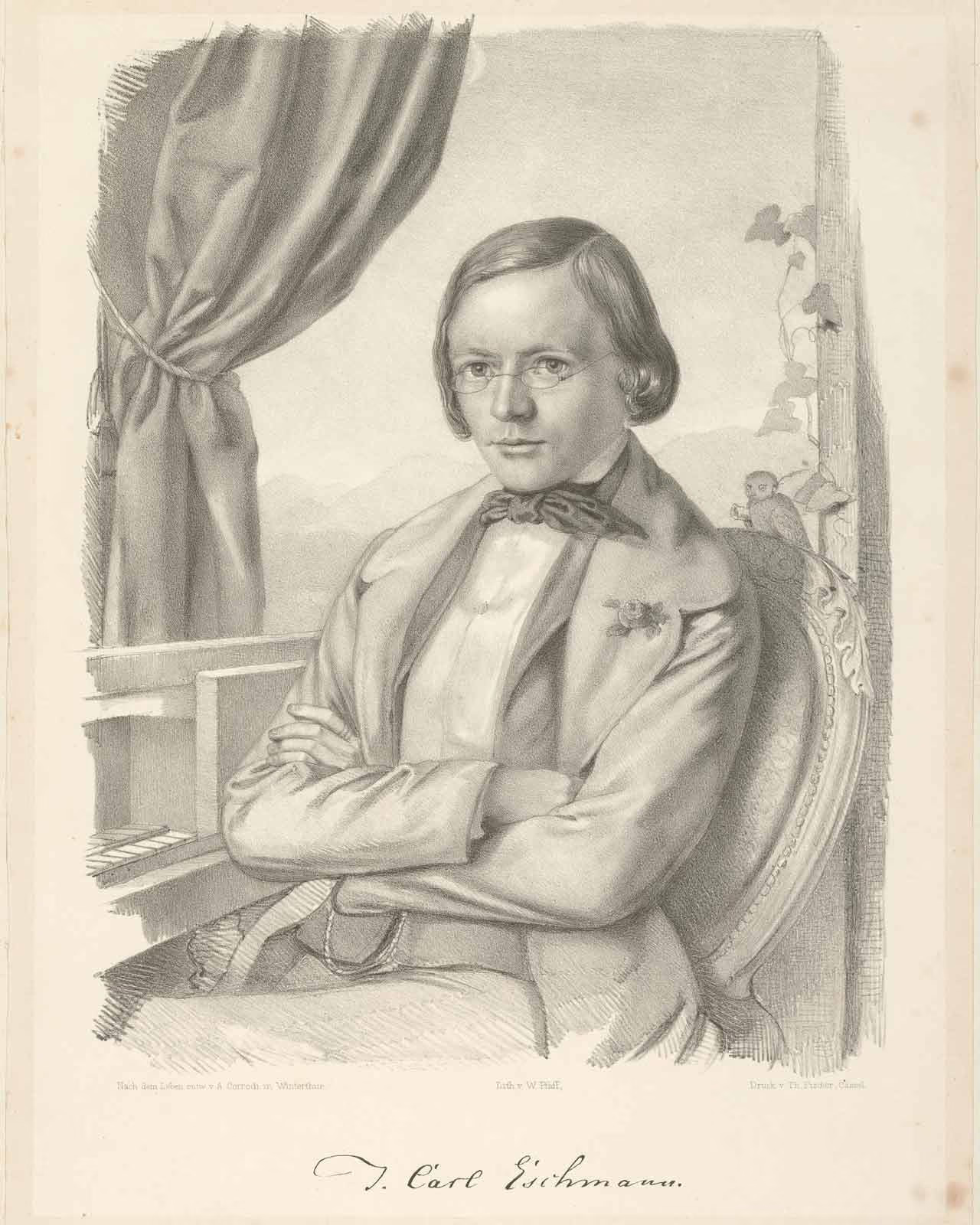
Johann Carl Eschmann
1828 (WINTERTHUR) – 1882 (ZURICH)
Johann Carl Eschmann was born in Winterthur in 1826. His father Hans Heinrich was the director of the Cantonal Military Band and a member of the Winterthur orchestra, the Musikkollegium. Johann Carl took piano lessons with Alexander Müller in Zurich, then from 1845 to 1847 studied under Felix Mendelssohn Bartholdy, Ignaz Moscheles and others at the newly founded Conservatory in Leipzig. After completing his training, he returned to Switzerland.
From now on, Eschmann devoted himself primarily to composing and to teaching piano, harmony and composition. He taught in Winterthur from 1850 to1859 and was later described as an “excellent, conscientious teacher” who “helped his students to achieve steady, uninterrupted progress thanks to an unremittingly strict teaching regime, while also inspiring them with love and enthusiasm for music”. His piano playing was never devoted to empty virtuosity, but was always intended to serve the music.
From 1859 to 1866, Eschmann worked as a music director and teacher in Schaffhausen, then moved back to Zurich where he taught and composed, with chamber music, piano music and the song with piano accompaniment his prime focus. Eschmann was friends with Johannes Brahms, but also with Louis Spohr and Richard Wagner. Brahms even recommended Eschmann successfully to his own publisher Simrock. Eschmann’s music cannot be categorised as belonging unequivocally to either the New German School or the conservative school of absolute music after the manner of Brahms, though the biggest influences on him were the music of Schumann and Mendelssohn. Eschmann died in Zurich on 27 October 1882; his archives are held today by the Zentralbibliothek Zürich.

_Komponist%2C_Musikpa%CC%88dagoge.avif)