Swiss Symphonic Music
Rediscovering the Swiss repertoire
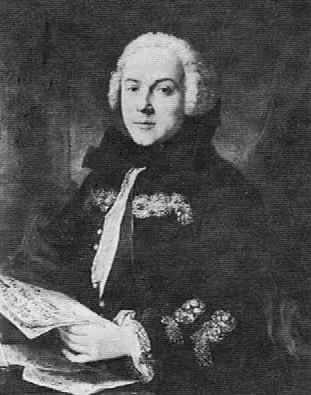
Joseph Franz Xaver Dominik Stalder
1725 (LUCERNE) – 1765 (LUCERNE)
A time there was when it was considered good form for a composer to bear an Italian name. This wasn’t merely because the Italian language sounds more musical, for there was also a strategy behind it. An Italian name offered better chances to market yourself in the music world, both at home and abroad. This is why the composer Joseph Franz Xaver Dominik Stalder, born in Lucerne in 1725, turned himself into one “Giuseppe Stalder”.
Stalder attended the Jesuit School in Lucerne and then went to Milan in 1746 to study both moral theology and music, and where his teachers included the influential Milanese Capellmeister Giovanni Battista Sammartini. Stalder was made a priest in 1749, after which he returned home and was appointed choral conductor in Hergiswald and then ‘Provisor’, an administrative post, at St. Leodegar’s in Lucerne.
But Stalder didn’t content himself with mere local matters, for he was a sought-after musician and composer with an international network. He worked variously in Mainz, London and Paris from the 1750s to the early 1760s and was also appointed capellmeister to the Princes of Monaco and Conti. In stylistic terms, Stalder’s music is pre-Classical, and his numerous instrumental works bear dedications that attest to his being acquainted with influential figures. Ill-health compelled him to return home to Lucerne in 1762 at the age of 37. He was there upon made the organist at St. Leodegar’s, but died three years later.
Despite his Italian name and his extensive network, only a portion of Stalder’s oeuvre remains extant today. Many of his compositions have been lost, and he himself descended into obscurity not long after his untimely death.

_OeNB_3781272_SO_WEB.avif)