Homeland! Swiss symphonic music
CHF
135 / 105 / 85 / 60/ 45

FethiKaraduman.avif)
About The Programme
Sometimes you just have to seize the day and grasp the chances life gives you. Like Wolfgang Amadeus Mozart back in 1781, when he gave up a safe position in Salzburg to go and strike out as a freelance composer and pianist in Vienna. He composed his Piano Concerto No. 12 in 1782, during this transitional period when he had already achieved initial success but was still far from being properly established. So he intended this concerto to occupy “the middle ground between being too difficult and too easy”. It was to be a work in which “connoisseurs alone will derive satisfaction, but in such a way that non-connoisseurs will also be satisfied, though they know not why”. To make his piece accessible to amateur musicians who played in private, Mozart structured his new concerto in such a way that it might also be accompanied by nothing more than a string quartet. What’s more, he hoped to get his works co-financed by patrons by offering a subscription to the tune of four ducats – not unlike today’s crowd-funding programmes. While this only brought him limited success, the first performance of his new concerto was nonetheless a hit. And the risks that Mozart took also found their reward: in 1785, he was able to finance his Piano Concerto No. 20 in D minor solely through the subscription concerts he had meanwhile established with himself as pianist – performing barely after the ink had dried on his manuscript paper. Mozart had become so good in his business that he was completing his works more or less to order. His gamble on Vienna had indeed paid off.
The Turkish pianist and composer Fazıl Say is also a man who doesn’t shy away from a challenge, whether by offering courageous criticism of social injustice in his homeland, or by mastering the technical impositions of the concert repertoire. In Andermatt, Say will perform both the aforementioned piano concertos. Unlike No. 12, which was aimed at gifted amateurs, No. 20 in particular makes demands that can only be truly fulfilled by real virtuosos. This programme is bookended by works by two near-forgotten Swiss composers: Joseph Lauber, who was born in Ruswil near Lucerne, grew up in the Jura, and in the late-19th and early 20th centuries created a significant oeuvre in which we repeatedly hear his impressions of the natural world of his Alpine homeland. Paul Juon came from a family of emigrant confectioners from the Canton of Graubünden. He was born in Moscow, and only in later life was able to fulfil his longing to return to his native Switzerland. All the same, nor did he forget the land of his birth, as is evident in the echoes of Eastern Europe in the “Quasi Polka” that features in the Andante of his Serenade Music. Lauber and Juon – if you’ve never yet heard of them, then it’s time for you to take a chance and rediscover them!
Lineup
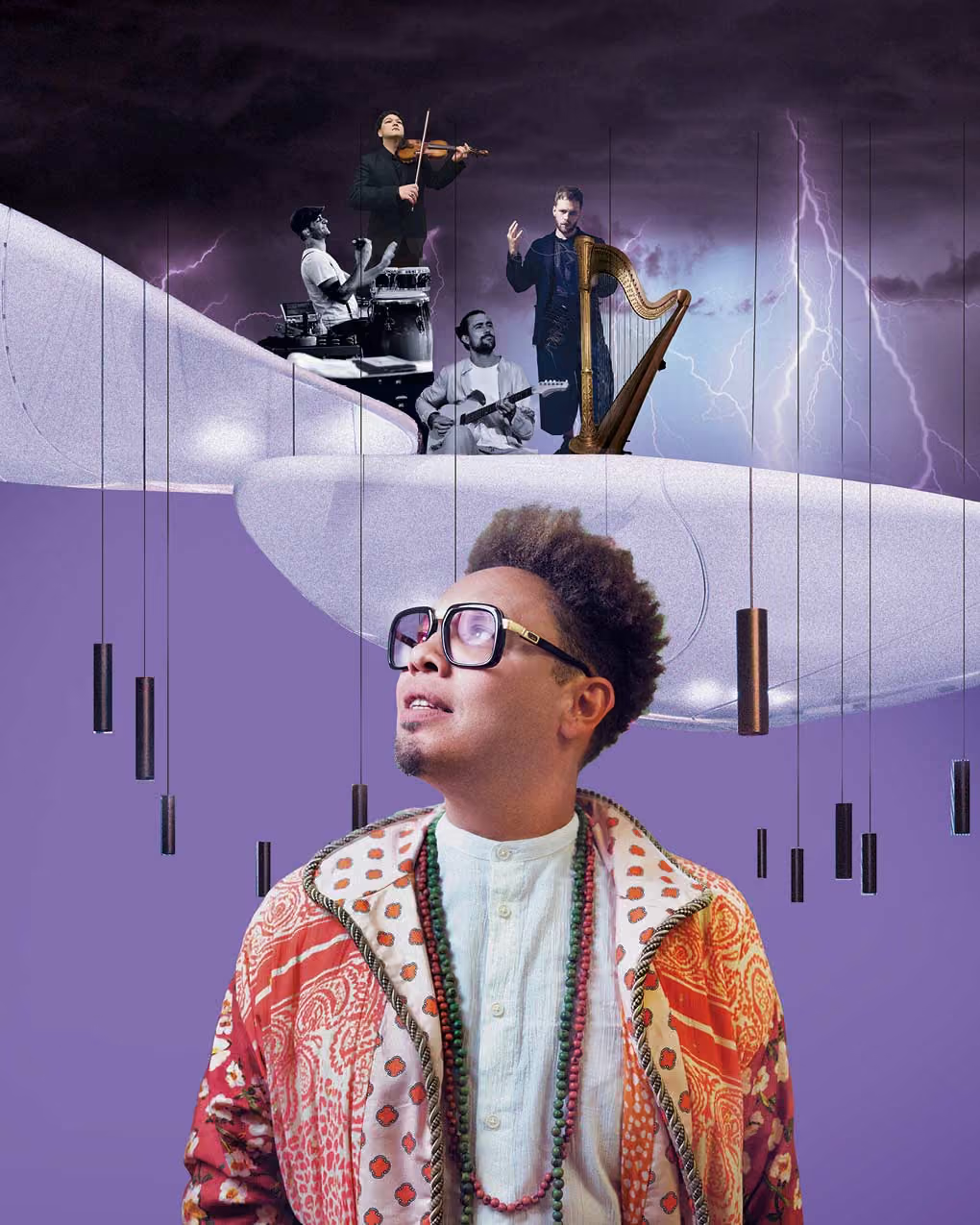
FAZIL SAY, piano
SWISS ORCHESTRA
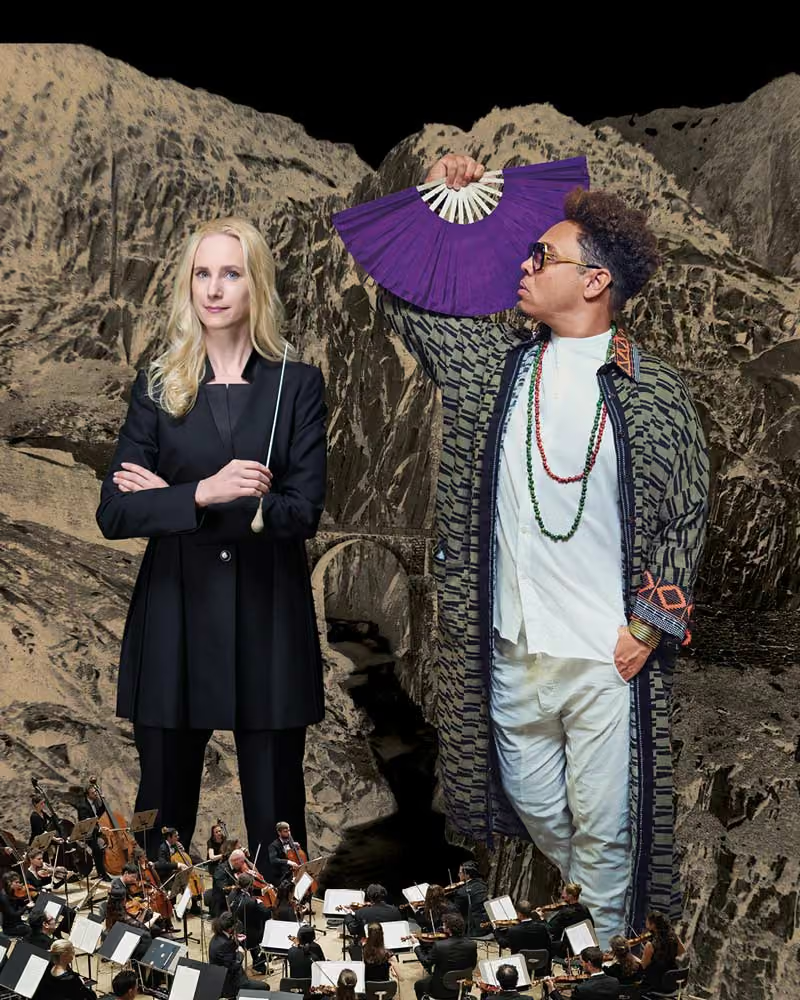
LENA-LISA WÜSTENDÖRFER, conductor
programme
JOSEPH LAUBER
Suite romande
WOLFGANG AMADEUS MOZART
Piano Concerto No. 12 in A major, K. 414
Piano Concerto No. 20 in D minor, K. 466
PAUL JUON
Serenade Music op. 40
- 19:00Doors open
- 19:30Start of concert
- 21:30Approx. end time
concert hall
Andermatt

How to get there
Details on how to get there can be found on the ANDERMATT MUSIC website.
barrier-free access
The Andermatt concert hall is barrier-free. Wheelchair tickets are available via email at info@andermattmusic.ch or at Andermatt Alpine Apartments at +41 41 888 78 00.
Seating on the balcony is recommended for people with reduced mobility. Chamber music concerts and New Folk Music concerts usually do not have grandstand seating: Here, all seats are accessible without steps.
The Andermatt concert hall has an inductive listening system.
Garderobe
evening ticket office
The box office opens 1 hour before the start of the concert.
Doors open / late entry
Admission to the concert hall is 30 minutes before the start of the concert. Late admission is only possible during applause between plays and on the guidance of the hall staff.
Discount
Discounts are available for children, students and members of the Gotthard MemberClub. Details about the benefits can be found here.
With his exceptional pianistic artistry, Fazıl Say has been captivating audiences and critics around the world for over 25 years – in a way that is uniquely his own, especially in today’s increasingly structured and commercialised classical music world. A concert with Fazıl Say is never just a performance. It is more immediate, more open, more electrifying. In short: it speaks directly to the heart. Since the beginning of his career, he has performed with many renowned American and European orchestras and numerous leading conductors, building up a diverse repertoire ranging from Bach to Viennese Classical, Romantic and contemporary music, including his own compositions for piano. Guest performances have taken Fazıl Say to countless countries on all five continents, alongside numerous appearances as a chamber musician.
As a composer, Fazıl Say has received commissions from leading institutions including the Boston Symphony Orchestra, Orpheus Chamber Orchestra, the BBC, Salzburg Festival, WDR, Munich Philharmonic, Schleswig-Holstein Music Festival, Wiener Konzerthaus, Dresden Philharmonic and the Fondation Louis Vuitton, among others. His oeuvre encompasses six symphonies, two oratorios, several solo concertos, as well as numerous works for piano and chamber ensemble.
Fazıl Say has built an extensive discography of over 50 recordings released on labels such as Teldec Classics, naïve and Warner Classics. His work has earned numerous accolades, including four ECHO Klassik Awards and a Gramophone Classical Music Award. In the 2025/26 season, the release of Fazıl Say’s major new work Mozart and Mevlana marks a powerful musical dialogue between East and West, premiered alongside Mozart’s Requiem and inspired by the poetry of Rumi. He also continues to release his own compositions on his own label, ACM. Say’s latest album, Oiseaux Tristes, released in 2024 on Warner Classics, was awarded the 2025 OPUS KLASSIK Award in the Solo Instrumental category.
For everyone who wants to hear Swiss symphonic music, and to live it too
Enjoy exclusivebenefits, get a glimpse behind the scenes, and do a good thing