The Bash: Part 1 – «Am Schärme»
CHF

About The Programme
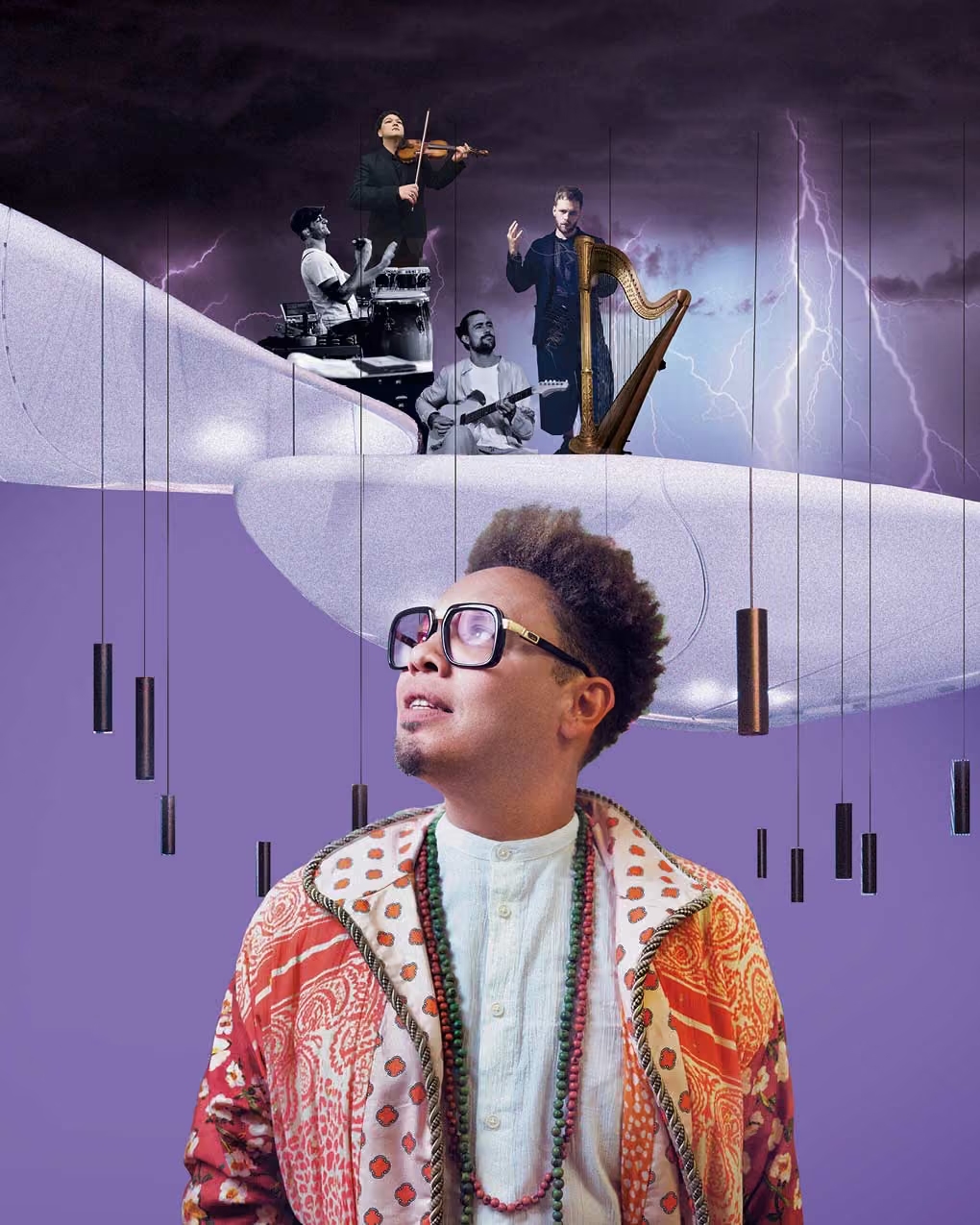
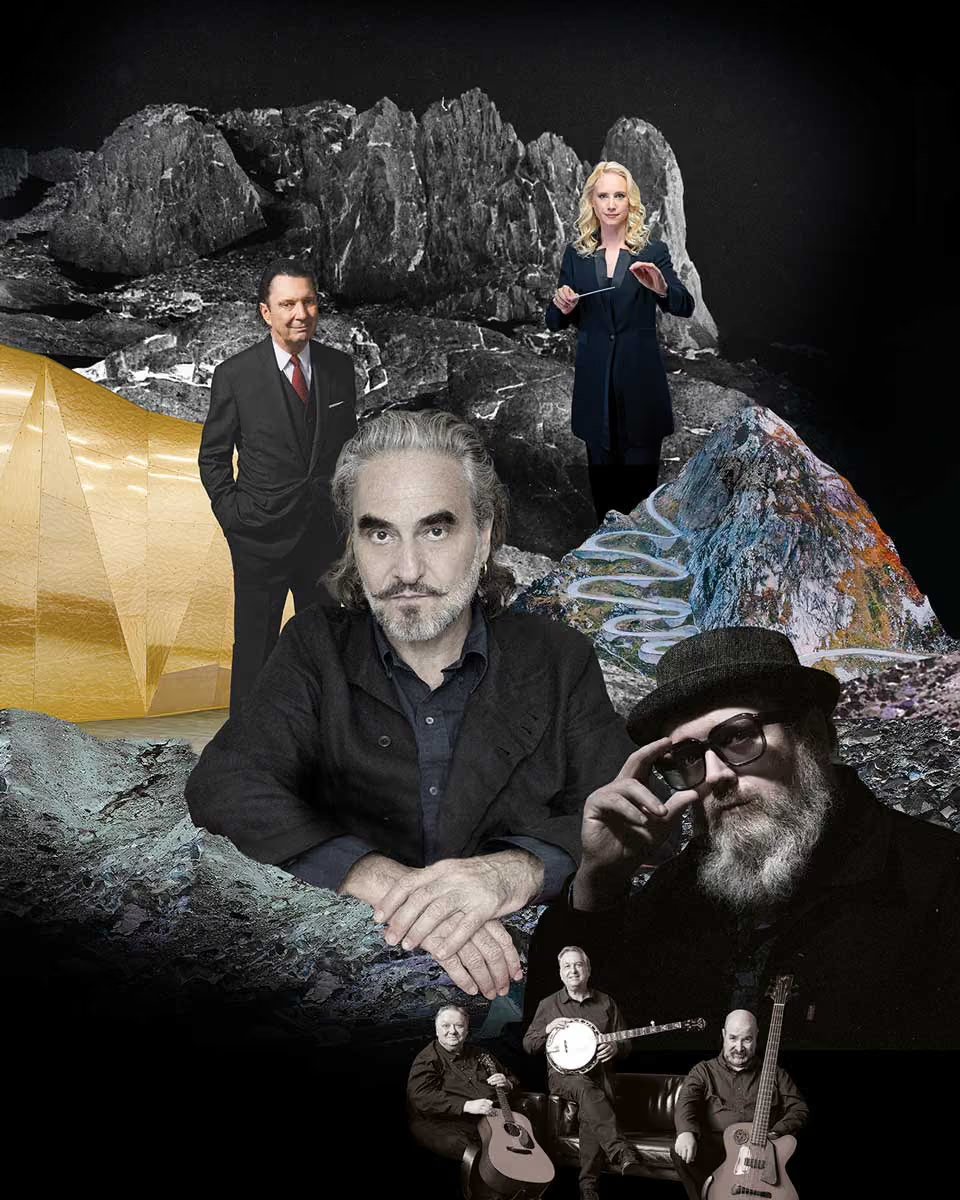
«Have you really gone mad?» That’s a question we’re more than happy to hear! Because it certainly does seem somewhat daring to bring together on stage Stephan Eicher (one of Switzerland’s most versatile, exciting musical personalities), the Kruger Brothers (two brothers from Aargau who set out to take North-American folk music around the globe), Martin Suter (the pop star among today’s Swiss writers) and the Swiss Orchestra under the baton of Lena-Lisa Wüstendörfer. And the result? Two inspiring concerts full of surprises, creativity and just a little pinch of craziness.
“The Bash” is in equal parts party, experimental laboratory and an act of collision. It’s the second such festival designed and organised by ANDERMATT MUSIC besides the Andermatt Goethe Days, and stands for innovation and openness. It is an adventurous leap across the gap between classical music and pop. “The Bash” is a laboratory for innovation and an experimental space that results not simply in pop music overlaid with a few orchestral instruments, but in an eccentric, exciting aggregate of different musical worlds.
These two concert evenings comprise two different programmes that have been conceived as a “Gesamtkunstwerk” – a total work of art – but can also be booked and attended separately.
Lineup
ARTISTE ÉTOILE: Stephan Eicher
THE KRUGER BROTHERS
REYN OUWEHAND
MARTIN SUTER
SWISS ORCHESTRA
LENA-LISA WÜSTENDÖRFER, conductor
programme
DEEP IN THE GOTTHARD
by MARTIN SUTER
It’s not easy finding a suitable rehearsal venue for a band and a whole symphony orchestra.
After several weeks, the search party charged with this task ultimately found what they were looking for on the Gotthard. More precisely: in the Gotthard, since the Gotthard massif is actually a huge fortress, a kind of underground Switzerland. So the band and orchestra took up lodgings in one of these fortifications.
The entrance was situated in an innocuous-looking alpine hut whose façade opened up like a garage door: behind it there was an armoured sliding gate whose hydraulics had been poorly maintained and squeaked unpleasantly.
From there, you went past disused artillery and through a short tunnel to reach a hall that had once served as an army canteen and a lecture room. It was ideal – as long as you ignored the pre-war ventilation system that interfered a little with the pianissimo passages.
It was in this fortress that the Swiss Orchestra spent three weeks rehearsing, together with its conductor Lena-Lisa Wüstendörfer, Stephan Eicher and his band, plus the Kruger Brothers, their technicians, roadies, cook, kitchen crew and in-house writer. They were cut off from the outside world except for an hour each day when they were free to go out on the alpine pasture.
It was on one such outing that the writer on duty, Martin Suter, got lost. The air outside was fresh, the sky turquoise, the sun as bright as a diamond – and so he ambled off along the nearest narrow cow path. Deep in thoughts of somewhere else, he kept on climbing. He didn’t notice just how swiftly everything fresh, white, turquoise and diamond-bright was obscured by wrathful clouds. It was only when cold, heavy raindrops fell on him and an icy gust tugged at his tie that he woke up to reality and returned gingerly down the path.
His track split up on two occasions, and he took the wrong one twice. When he finally arrived back at the alpine hut, his hour of leisure was long used up. He knocked on the door and on the closed shutters, first shyly, then desperately, then in a spirit of resignation. No one heard him through the armoured door behind the fake façade.
He sat down, shivering, on a mock log of wood.
In the rehearsal room, they reached the spot in the score where Martin Suter was supposed to tell one of the stories about how the next song had been written. But when a spotlight shone on where he was to have been sitting, it illuminated only an empty chair and a little table with a few sheets of paper and a mouth organ.
Shortly afterwards, Suter heard the hydraulic squeaking of the sliding gate and got up stiffly from his dummy log. The façade lifted for him to find Stephan Eicher, the band and the entire symphony orchestra standing before him.
Eicher took him by the hand and said: “Chum a Schärme” – “come in where it’s dry”.
Martin Suter spent five days in a narrow bed in one of the 12-man dormitories, getting over his cold. That’s where he wrote the text for “Am Schärme”.
Everyone liked it so much that when he bade his farewells after recovering, Stephan Eicher asked him to “Blib no chli” – “Stay a bit”.
That’s how “Blib no chli” was written.
- 19:00Doors open
- 19:30concert (incl. break)
- 21:30Approx. end time
concert hall
Andermatt

How to get there
Details on how to get there can be found on the ANDERMATT MUSIC website.
barrier-free access
The Andermatt concert hall is barrier-free. Wheelchair tickets are available via email at info@andermattmusic.ch or at Andermatt Alpine Apartments at +41 41 888 78 00.
Seating on the balcony is recommended for people with reduced mobility. Chamber music concerts and New Folk Music concerts usually do not have grandstand seating: Here, all seats are accessible without steps.
The Andermatt concert hall has an inductive listening system.
Garderobe
evening ticket office
The box office opens 1 hour before the start of the concert.
Doors open / late entry
Admission to the concert hall is 30 minutes before the start of the concert. Late admission is only possible during applause between plays and on the guidance of the hall staff.
Discount
Discounts are available for children, students and members of the Gotthard MemberClub. Details about the benefits can be found here.
Stephan Eicher discovered the stage in 1977 with his first band, “Noise Boys”. Two years later, he founded the techno-punk band “Grauzone” – today considered a pioneer of electronic music – together with his younger brother Martin Eicher. It was at this time that Stephan Eicher first went into the recording studio. The result was the single “Eisbär”, which sold 500,000 copies in Germany and Switzerland. In late 1983, he released his first solo album, “Chansons bleues”, which firmly established him in the music world. His big triumph came in 1986 with his album “I tell this night”, from which the single “Two people in a room” quickly became a hit. In March of that same year, Stephan Eicher filled the legendary Olympia concert hall in Paris. “Combien de temps”, the first single from his third album “Silence”, also soon became a classic of his repertoire. From this album onwards, Stephan Eicher revealed further musical facets by devoting himself increasingly to playing with other artists for the sheer joy of making music.
For everyone who wants to hear Swiss symphonic music, and to live it too
Enjoy exclusivebenefits, get a glimpse behind the scenes, and do a good thing