Season Opening
CHF
135 / 105 / 85 / 60 / 45

About The Programme
A classical symphony orchestra features lyrical violins, warm violas, noble cellos and ponderous double basses; then there are frisky flutes, wistful oboes, mysterious clarinets and sonorous bassoons; and they’re all rounded off by resplendent horns, brilliant trumpets, majestic trombones and thundering timpani. Oh, and of course, there’s one more: the triangle. The poor triangle has had to put up with more than its fair share of ridicule. The Austrian cabaret singer Georg Kreisler even once devoted a strophe in a song to the triangle player in an orchestra: “I don’t come in till page 89 / Yes, I’ve got plenty of time / I could get out a book and read a bit, but now the conductor’s looking at me / And straightaway I stand up and go [ping]”. At least the triangle player’s work-life balance is in a pretty decent spot.
But there’s one work where the triangle player has a lot more to do: Franz Liszt’s Piano Concerto No. 1, more specifically the beginning of its third movement, where the triangle’s role is transformed from a tiny character part into a joint protagonist. And in this case, it was the composer himself who became an object of scorn on account of his unusual use of the instrument. His concerto was even derided as a “triangle concerto accompanied by piano and orchestra” – a quip attributed appropriately to the witty but scurrilous doyen of music critics Eduard Hanslick. His target wasn’t just Liszt’s orchestration here, but the aesthetics of programme music as championed by Liszt and Richard Wagner. Hanslick was of the opinion that it’s not music’s role to express feelings or tell stories, but is complete in itself instead. He was an advocate of its aesthetic autonomy. Thus, for example, he also held Beethoven’s symphonies in the highest possible regard – except for the Sixth, the Pastoral, on account of its programmatic content.
And what about Joachim Raff, a native of Canton Schwyz – how did he position himself in the debate about the future of music that dominated the scene in the 19th century? As a sometime disciple of Liszt, he gave most of his symphonies descriptive titles. But a critical book that he published on Wagner in 1854 also annoyed the adherents of programme music. When he was made the first director of the Hoch Conservatory in Frankfurt am Main, he made sure to keep a balance between musical progressives and conservatives among his staff (perhaps a quality of his that was typically Swiss?). And in his Orchestral Suite No. 1, op. 101 that features on our programme here, he – prudently, perhaps – refrained from writing for the triangle!
Lineup
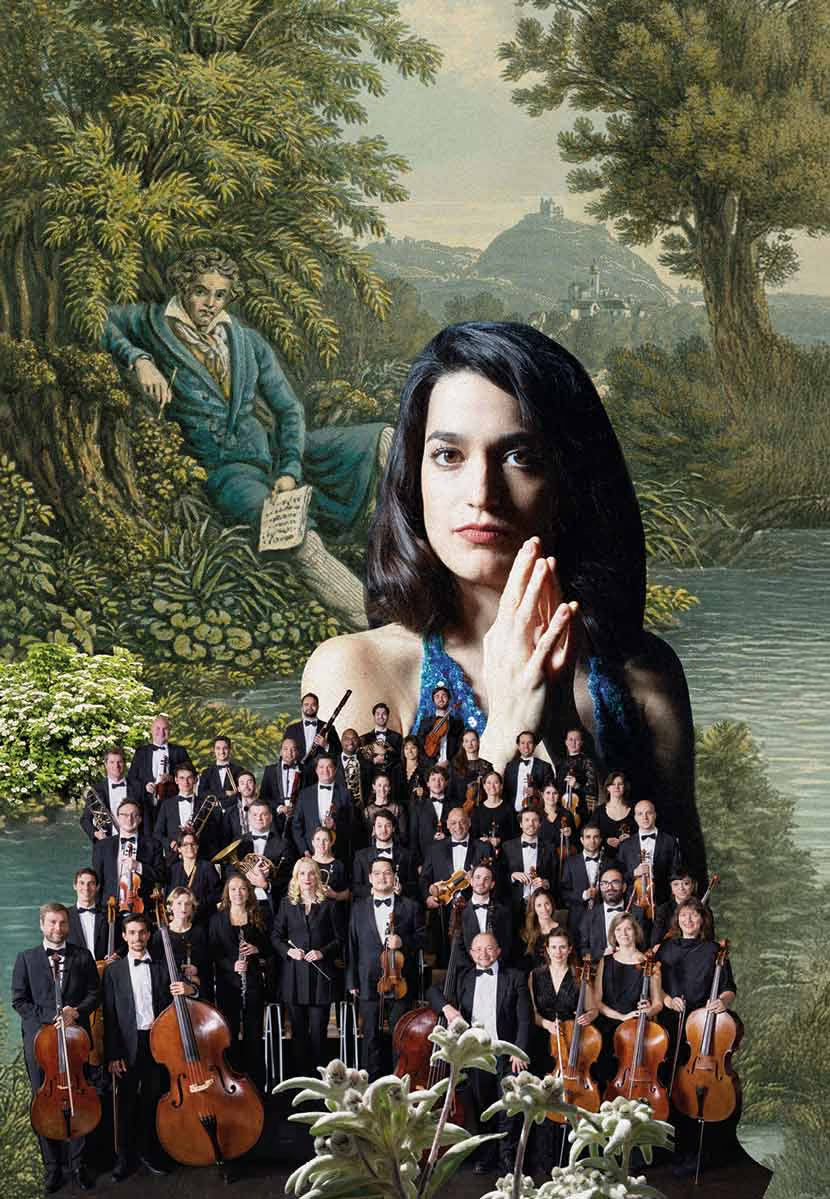
SASKIA GIORGINI, piano
SWISS ORCHESTRA
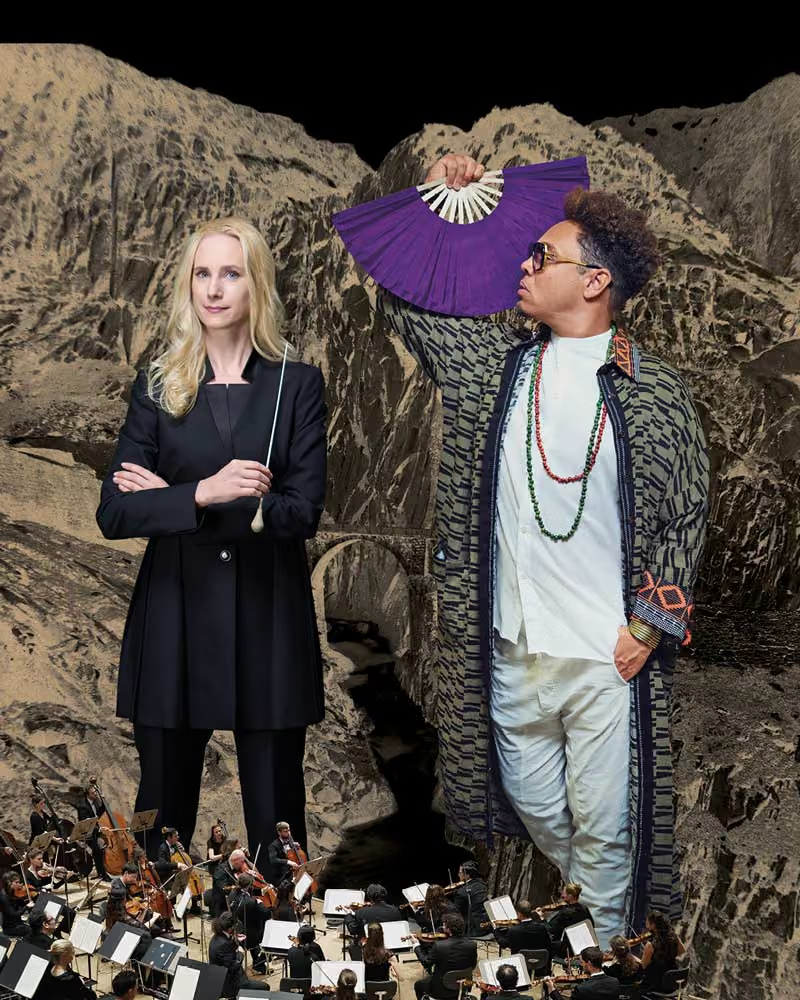
LENA-LISA WÜSTENDÖRFER, conductor
programme
JOACHIM RAFF
Excerpt from Suite No. 1 op. 101
FRANZ LISZT
Piano Concerto No. 1 in E-flat major
LUDWIG VAN BEETHOVEN
Symphony No. 6 in F major op. 68, Pastoral
- 19:00Doors open
- 19:30Start of concert
- 21:30Approx. end time
concert hall
Andermatt

How to get there
Details on how to get there can be found on the ANDERMATT MUSIC website.
barrier-free access
The Andermatt concert hall is barrier-free. Wheelchair tickets are available via email at info@andermattmusic.ch or at Andermatt Alpine Apartments at +41 41 888 78 00.
Seating on the balcony is recommended for people with reduced mobility. Chamber music concerts and New Folk Music concerts usually do not have grandstand seating: Here, all seats are accessible without steps.
The Andermatt concert hall has an inductive listening system.
Garderobe
evening ticket office
The box office opens 1 hour before the start of the concert.
Doors open / late entry
Admission to the concert hall is 30 minutes before the start of the concert. Late admission is only possible during applause between plays and on the guidance of the hall staff.
Discount
Discounts are available for children, students and members of the Gotthard MemberClub. Details about the benefits can be found here.
Praised for the poetry, depth and clarity of her playing, Saskia Giorgini has established herself as one of today’s most compelling pianists. Alain Lompech wrote of her: “Saskia Giorgini sings, dreams and abolishes time. She is inside the sound and the form: expression and abstraction, color and line, both in the moment and in infinity.” Her recent recordings for Pentatone – Images (Debussy), Consolations (Liszt) and Harmonies Poétiques et Religieuses (Liszt) – have met with exceptional international acclaim, with Images named a finalist for the 2025 Gramophone Awards. Her releases have earned two Diapasons d’Or, multiple Gramophone distinctions, a Choc de Classica, and BBC and International Piano picks of the month. She has also recorded Schubert’s Die schöne Müllerin with Ian Bostridge, and a Mozart/Shostakovich album with the Trondheim Soloists is forthcoming (November 2025).
The winner of the International Mozart Competition in Salzburg in 2016, Giorgini has since performed in major venues including Teatro La Fenice in Venice, Teatro Regio di Torino, the Concertgebouw in Amsterdam, Wigmore Hall in London, Suntory Hall in Tokyo, the Konzerthaus and Musikverein in Vienna, the Mozarteum Salzburg, and the Filharmonia Narodowa in Warsaw. She has appeared with orchestras such as the Tokyo Metropolitan Symphony, the CBC Radio Orchestra and the St. Petersburg Philharmonic, collaborating with conductors including Eliahu Inbal, Simon Gaudenz, Mario Bernardi, Andrea Battistoni and Hannu Lintu. A dedicated chamber musician, she regularly partners with Ian Bostridge, Vilde Frang, Janine Jansen, Martin Fröst, Mario Brunello and Thomas Demenga. Forthcoming highlights include the Elbphilharmonie, Enescu Festival, and a two-season residency at L’Auditori Barcelona. Since 2023 she has held a piano professorship at the Anton Bruckner Privatuniversität in Linz, and serves on competition juries including the Busoni (2025) and the Liszt Competition Utrecht (2026).
For everyone who wants to hear Swiss symphonic music, and to live it too
Enjoy exclusivebenefits, get a glimpse behind the scenes, and do a good thing