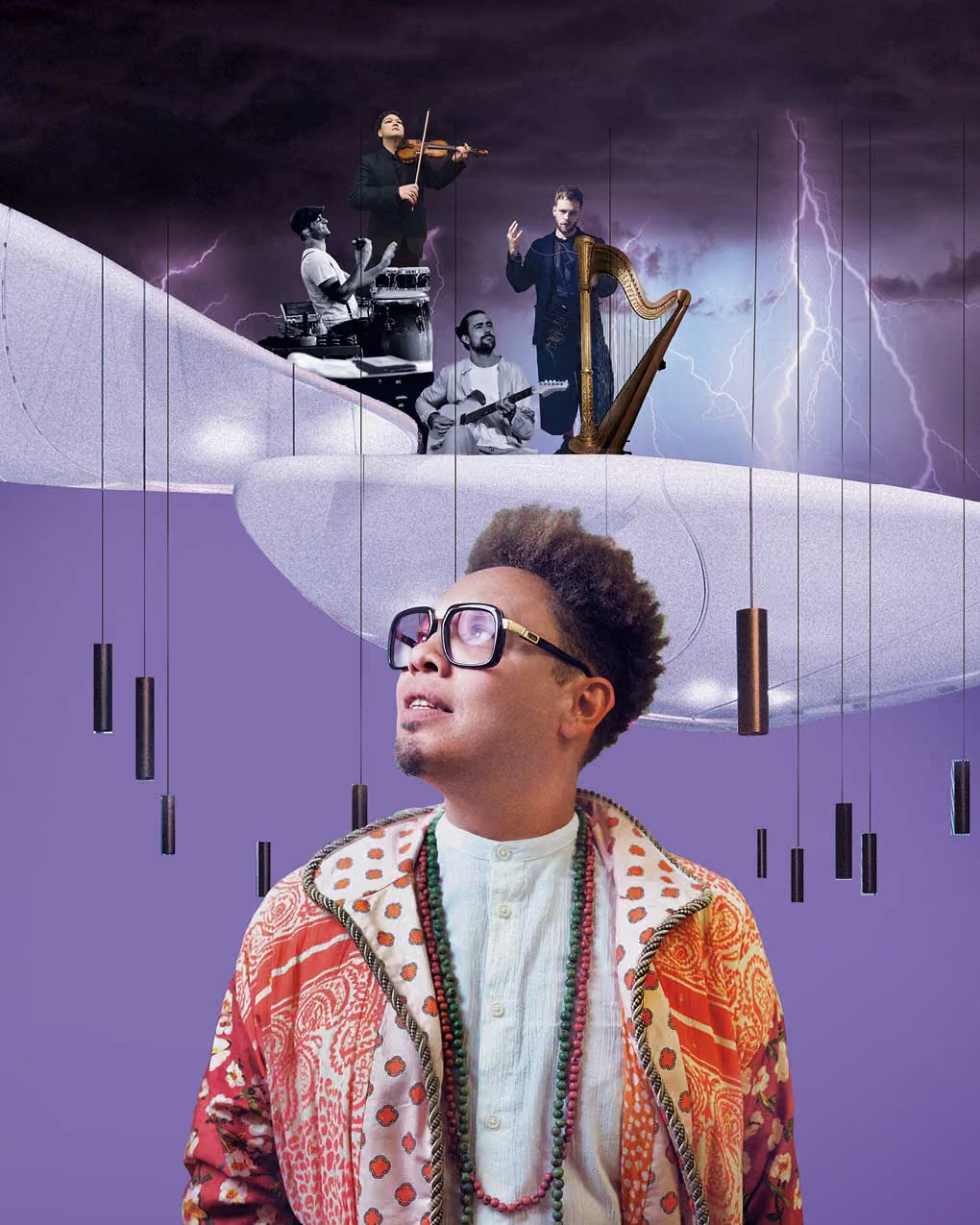
Love is in the Air
CHF
20–68


About The Programme
“Dear Madam”, “Most revered Madam”, “My darling friend”, “My most beloved friend”. These different forms of address, which all come from the pen of Johannes Brahms in his letters to Clara Schumann, serve as a kind of barometer of his emotions and testify to their growing intensity and intimacy. The young Brahms long retained the polite, “Sie” form of address in his letters, but in 1854, when Clara suddenly used the familiar “Du” form instead, he replied ecstatically: “How lovingly the familiar ‘Du’ looks out at me! A thousand thanks for it. I can’t look at it and read it enough […]; rarely have I missed the word so much as when I read your last letter”. His delight in this intimate form of address in 1854 did not lead him to respond in kind until 1856, but by which time he wrote: In 1856 he wrote: “My beloved Clara, I wish I could write to you [‘Dir’, using the intimate form] as tenderly as I love you. […] Your letters are like kisses to me”. There has been ample speculation about the nature of their relationship. What’s clear is that Johannes was infatuated with Clara, that a lifelong friendship was the result of this, that he supported her and her children to the end of his life, and that he sought her advice in musical matters. But Clara was also, of course, the loving wife of Robert Schumann.
Robert and Clara had had to fight through the courts to be able to marry. After they were successful, they kept a joint diary and enjoyed happy years together in which they constantly reaffirmed their fidelity and love for each other. In 1845, Robert completed his Romantic piano concerto, and the soloist at its world premiere was of course his wife Clara, who had been the inspiration behind it and advanced to being its most significant interpreter. And Robert had already inscribed her name into the work at the outset: After a forceful tutti chord in the orchestra and a cascading progression of chords on the piano, there follows a dreamy, lyrical first subject that we hear initially on the oboe and that begins with the notes C–B–A–A, which is a musical version of Robert’s pet name for Clara, namely “CHiArA” (the note “B” in English being called “H” in German). The second work of our concert programme is Brahms’s Symphony No. 1, which is also connected to Clara. During a visit to the Swiss Alps in 1868, Johannes sent her a birthday greeting on which he notated an alphorn melody that he had just heard, and which he later used in the last movement of this Symphony. And Clara was also the first person to whom he played the symphony on the piano. She was critical of its first version, but was convinced of its quality at the world premiere. So all three of them – Clara, Robert and Johannes – remain linked to this day not just by their biographical connections, but by the idea that great music can spring from great love – sometimes romantic, sometimes tragic, and sometimes platonic. What could be more beautiful for a Valentine’s Day Concert?
Lineup
OLGA SCHEPS, piano
SWISS ORCHESTRA
LENA-LISA WÜSTENDÖRFER, conductor
programme
ROBERT SCHUMANN
Piano Concerto in a minor, op. 544
JOHANNES BRAHMS
Symphony No. 1 in c minor, op. 68
- 19:30Doors open
- 20:00Start of concert
- 22:00Approx. end time
Philharmonie
Cologne

How to get there
BY PUBLIC TRANSPORTATION
5 minutes on foot from Cologne Central Station
“Rathaus” and “Heumarkt” stops
BY CAR
The Philharmonie car park offers concert-goers a special price of €2.50 for up to six hours from arrival. Present your ticket together with the parking ticket before or after the concert at the ticket office in the car park to activate the concert rate. Payment is only possible in cash at the cash desk, and also by card at the vending machine.
Follow the signs “Dom/Hauptbahnhof”. The “Philharmonie” car park is signposted from the city center.
INFORMATION FOR NAVIGATION DEVICES
CONTIPARK Tiefgarage Philharmonie, Bischofsgartenstraße, CologneCoordinates: 50.94066342401113, 6.961351411430333
IMPORTANT NOTES:
- The parking garage is Accessible from Rheinuferstraße (Konrad-Adenauer-Ufer/Am Leystapel). Traffic jams may occur in the Trankgasse tunnel due to increased traffic.
- Access via Komödienstraße is blocked for motor vehicles.
- If necessary, also use surrounding parking garages in the city center; there is no concert rate there.
- Traffic can be particularly high in the run-up to Christmas, on Sunday sales and at major events — plan enough time to get there.
ENVIRONMENTAL STICKER
The Cologne Philharmonic is located within the Cologne environmental zone. Please make sure that your vehicle has the appropriate sticker. Vehicles of severely disabled people with the marks “aG”, “H” or “Bl” are excluded.
barrier-free access
barrier-free access
The Cologne Philharmonic is easily accessible by car, making it easy to get on and off. Our foyer team will be waiting for you at the main entrance on the ground floor to help you open the doors. The Cologne Philharmonic has a directly adjacent parking garage with a total of nine parking spaces for the disabled.
For wheelchair users who come to us by car, use of the Philharmonie car park is free of charge. You can also reach the Cologne Philharmonic by public transport from Cologne Central Station and Heumarkt without having to climb steps.
WHEELCHAIR USERS
For wheelchair users, there are twelve parking spaces in seating blocks R and S in the hall. The accompanying persons sit in wheelchairs right next to the guests. These seats can be reached via an elevator at the cloakroom in blocks C, F, X, Y on the left side of the foyer. In block Z at the back of the stage, there are an additional two seats for wheelchair users, each with an accompanying person. These seats can be reached via an elevator at the cloakroom Q, P, N on the right side of the foyer. A mobile lift platform is available for Block Z, which our staff will help you operate.
ORDER TICKETS FOR WHEELCHAIR USERS
Seats for wheelchair users and their accompanying persons are usually available in blocks R & S at KölnMusik events and, if available, in block Z. The accompanying person receives free admission, but needs their own ticket. Tickets for wheelchair users are available by telephone on 0221/280 280 or at the Cologne Philharmonic box office.
WITH ROLLATOR OR MOBILITY RESTRICTION
For people with slight walking difficulties, we recommend the last row of intermediate blocks K and P. These seats can be reached by lift without steps. This also applies to the last row seats in Block Z (choir gallery). Rollators must be dropped off at the cloakrooms. If you need help, our lobby team is happy to help.
GUIDANCE FOR VISUALLY IMPAIRED PEOPLE
Blind or severely visually impaired people can easily visit the Cologne Philharmonic Orchestra alone or with an accompanying person. The Philharmonic is located close to Cologne Central Station, making it easy to travel by public transport. There is a larger main entrance, behind which the vestibule is located. The card tearers are at the second door and there is a large foyer behind them. In the foyer, it's best to go straight to the left, because that's where the information counter is and further back in the room is the cloakroom. If you are in the Philharmonie without seeing someone, the information desk staff will help you find a place.
The most convenient access from the foyer to the hall is a wide staircase that leads from the main entrance straight up at the end of the foyer into the entrance of the hall. There are also more cloakrooms and stairs into the hall on the right side of the foyer. You can drop off your coat at the cloakroom free of charge and receive a square chip with a number. After the concert, you can exchange the chip for your coat.
The architecture of the concert hall is reminiscent of an ancient amphitheatre: The round podium is located approximately in the middle of the room. On one side of the round podium, the rows of seats rise steeply upwards. At the back of the podium, the choir gallery (block Z) and the balconies are arranged one above the other on two floors. A large concert organ is installed to the left of the podium.
The seats are divided into blocks, which are listed alphabetically. Blocks A, B, E, D and choir gallery Z are closest to the podium. The blocks C and F are oriented in the middle of the podium but a little further away. The blocks G, H, L, Q, N and M are connected in a semicircle behind them. Blocks I, K, R, P, O and S are located at the upper entrance. The balconies are blocks X and Y.
The acoustics are excellent everywhere. Blocks C, F, L or Q are recommended, as they are very easy to reach, as the straight wide staircase from the foyer leads there. If you want to buy refreshments during the break, the main foyer and the Rheingarten foyer are easy to find from these blocks. You have to go back up the stairs from the row of seats into the lobby and then turn right towards the Rheingarten foyer or left towards the main foyer.
ASSISTANCE DOGS
You can also visit the Philharmonie with an assistance dog. The choice of seats is limited. To buy tickets, please contact cards @koelnmusik.deto book a suitable seat with enough space for your four-legged friend. Our local foyer team will then help you on the day of the concert. After admission, please contact the information desk on the left in the foyer.
REDUCTIONS
As a person with severe disabilities, you receive a 25% discount at almost all concerts.
The person accompanying a severely disabled person (symbol “B”) receives a 50% discount. The person accompanying a wheelchair user receives free admission. Please note: Only one discount can be claimed at a time. The proof of discount must be presented unsolicited upon admission. Different discounts and regulations may apply for partner events.
TOILETS
Wheelchair-accessible unisex toilets with emergency alarms are located in the foyer on the main entrance level next to the mirror bar and in the gallery on the level of seating blocks R and S (accessible by lift). The toilets are fitted with a screw lock and do not require an extra key. The ladies' and men's toilets in the basement of the foyer are also equipped with special toilets with a raised seat and grab bars.
Garderobe
Jackets and bags can be dropped off at the cloakroom free of charge at all concerts.
evening ticket office
Doors open / late entry
Admission starts 60 minutes before the start of the concert. For introductions, the house opens 15 minutes before the start of the introduction. As a rule, you can take your seats 30 minutes before the start of the concert — or as soon as the rehearsal is over.
If you are late, please contact a member of the lobby team. They will try to let you in as early as possible, but asks for your understanding that disruptions to ongoing events should be avoided as far as possible. In exceptional cases, this may mean that you can only take your place during the break.
Discount
Olga Scheps, daughter of Ukrainian pianists, born in Russia and living in her adopted home of Germany since 1992, represents great sound culture, intense expressiveness and a gift for storytelling. She discovered the piano at the age of 4 and was encouraged early on by piano greats such as Alfred Brendel. Renowned conductors such as Thomas Dausgaard, Lorin Maazel, José Serebrier, Marcus Bosch, Tugan Sokhiev, Simone Young, Markus Poschner and Pablo Heras-Casado invited Olga Scheps to collaborate with renowned orchestras such as the Orchestre Philharmonique de Monte-Carlo, the Warsaw Philharmonic Orchestra, the Mozarteum Orchestra Salzburg, the Royal Scottish National Orchestra, the Russian State Orchestra Moscow, the Staatskapelle Weimar, the Zurich Chamber Orchestra, the Orchestre National du Capitole de Toulouse and the Prague Philharmonia.
Olga Scheps has performed to great acclaim in world-famous concert halls such as the Philharmonie Berlin, Elbphilharmonie Hamburg, Cologne Philharmonie, Alte Oper Frankfurt, Tonhalle Zurich, Tonhalle Düsseldorf, Cadogan Hall London, Suntory Hall Tokyo and the Vienna Konzerthaus. She is a sought-after guest at renowned festivals in Germany and Switzerland and loves to play in chamber music ensembles. She is an exclusive Sony Classical artist. Her debut album Chopin won an ECHO Klassik award in 2009. This was followed by the recordings Russian Album (2010), Schubert (2012), Vocalise (2015) and a recording of Chopin’s Piano Concertos Nos. 1 and 2 with the Stuttgart Chamber Orchestra. In 2021, she released Family. This album combines famous classical works with new piano arrangements of well-known melodies and soundtracks, as well as previously unreleased compositions by Schiller (Christopher von Deylen), Chilly Gonzales and Olga Scheps herself. She is an official Steinway Artist since 2013.
For everyone who wants to hear Swiss symphonic music, and to live it too
Enjoy exclusivebenefits, get a glimpse behind the scenes, and do a good thing